EN
Quick Links
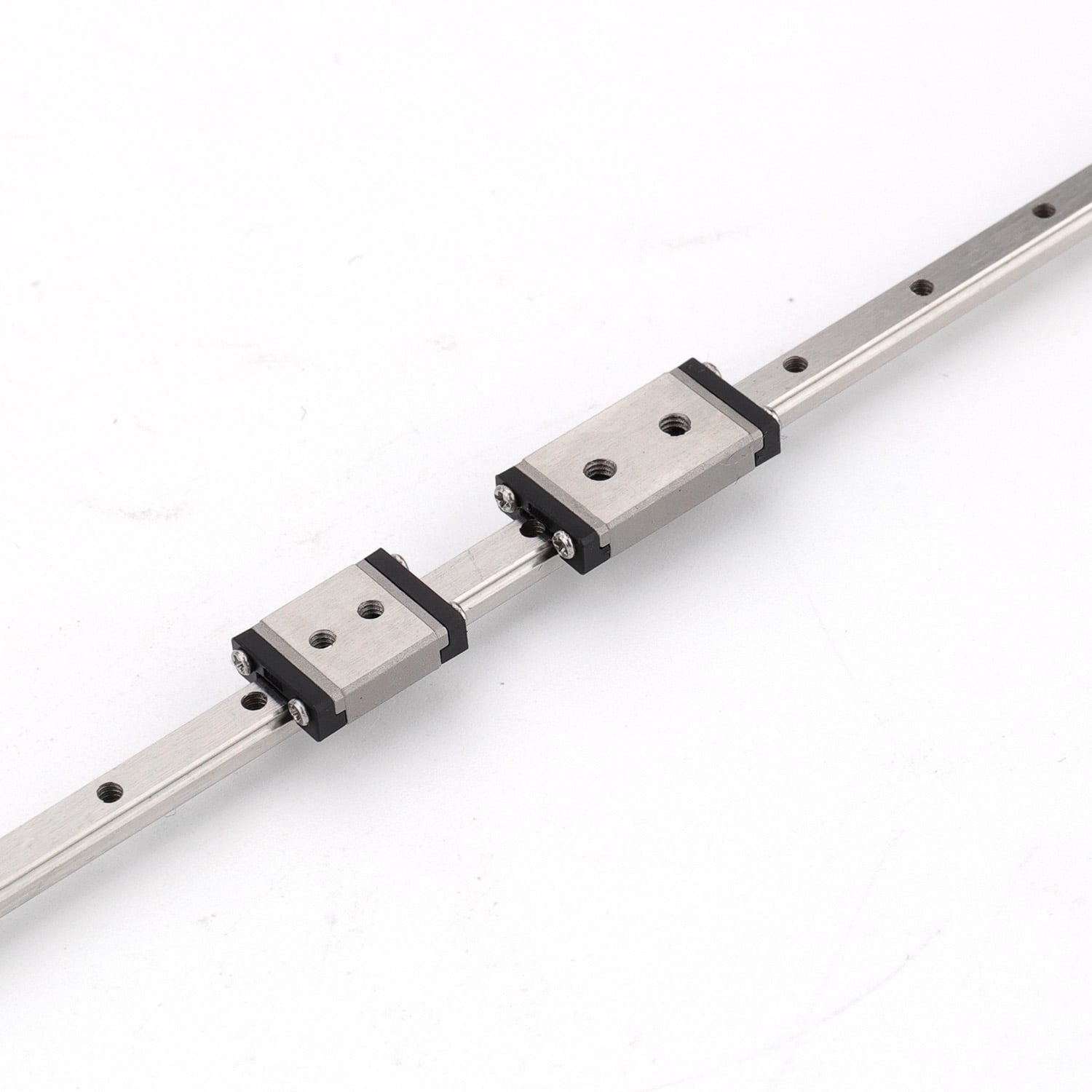
The MGN3 miniature linear guideway is a 3 mm wide rail system — a four-row ball circulation block running on a 3 mm profile rail — and its advantage is being the smallest size in the MGN range that still carries a useful load: 0.29 kN dynamic, 0.44 kN static, 0.7 N·m static moment, with a 1 g block on a rail that weighs 50 g per metre. Engineers choose it when the axis is short, the payload is light and the design is limited by space rather than by force. Size up to MGN5 or MGN7 when deflection, travel length or service life becomes the binding constraint.
That is the short answer. The rest of this article gives the numbers behind it, the applications where MGN3 is the correct choice, and the cases where it is not.
All values are catalogue ratings per block for the MGN3 miniature linear guideway, taken from the manufacturer's published MGN specification table.
An MGN3 guideway is a rolling-element linear bearing: a hardened stainless steel rail with two ground raceways, and a block containing four rows of steel balls that recirculate as the block travels. The balls contact the raceway at 45°, so the block is preloaded against both rail flanks and resists load from above, below and both sides with the same stiffness.
The "3" in the part number is the rail width in millimetres — not the block width, not the stroke. An MGN3 rail is 3 mm wide, which is what makes the series interesting: at that width the rail can sit inside a housing, behind an optical path or alongside a miniature gripper where a 5 mm or 7 mm rail simply will not fit. MGN2 (2 mm) exists below it, but the load ratings drop to a level that only suits the very lightest mechanism, so MGN3 is usually the practical floor for a driven axis.
A 1 g block and a 50 g/m rail mean the reciprocating mass is measured in grams, not kilograms. For an axis that reverses direction hundreds of times per second — a dispenser head, an inspection scan, an optical shutter — inertia, not load capacity, sets the speed limit. Halving the moving mass roughly halves the motor torque needed for the same acceleration.
Because the four ball rows are arranged symmetrically, an MGN3 block has the same stiffness against downward, upward and lateral loads. That matters in instruments that are assembled in one orientation and then run in another — a probe head that hangs sideways, a stage mounted on a vertical wall — because the designer does not have to re-rate the block for a different load direction.
0.29 kN of dynamic rating on a 3 mm rail is roughly 30 kg of continuous load capacity in ideal conditions. The margin is what lets a preloaded block run smoothly: at a working load of 50–100 N the balls stay in the elastic range and repeatability holds.
Sliding guides, and poorly lubricated dovetails in particular, alternate between sticking and jumping at low feed rates. A ball guide does not: the friction coefficient stays around 0.003–0.005 and the transition from static to moving is smooth. For an instrument that creeps at a few micrometres per second, this is the difference between a clean signal and a saw-tooth.
An MGN3 block is short in section height. Two or three axes stack without exceeding the instrument envelope, which is why this size appears in crossed-stage and gantry-in-a-box designs.
The two blocks share the same rail. The H variant is longer, so it carries more load and more moment on the same 3 mm profile:
The trade-off is mass and length, not stiffness. Choose the H block when the load is offset from the rail axis, when the head overhangs, or when a single rail carries the moment; choose the C block when the envelope is tight and the load is centred.
Basic rating life for an MGN3 miniature linear guideway follows the standard rolling-bearing relationship, published for linear motion bearings in ISO 14728-1 and used in the L10 form by every major linear guide manufacturer:
L10 = (C / P)³ × 50 km
where C is the basic dynamic load rating and P is the applied load per block.
Take an instrument axis where each of two blocks carries 100 N (P = 0.1 kN):
Two things follow from the cube. First, life is extremely sensitive to load: doubling the load cuts rating life by a factor of eight, so a design that runs at 30 % of C lasts roughly 37 times longer than one that runs at C. Second, when a design falls short on life, moving from the C block to the H block on the same rail buys about 2.4 times the life for one extra gram of moving mass — usually cheaper than moving up a rail size, which changes every mating part.
Life is a rating, not a guarantee. Contamination, lubrication interval, rail straightness and installation error all consume margin, and in a 3 mm guide they consume it faster than in a 15 mm one because the seals and the lubricant reservoir are proportionally smaller.
Wafer handling, die bonding, wire bonding and probe stations use MGN3 where the head must reach into a small working volume. The guide is chosen for envelope and smoothness rather than capacity, and the low particle generation of a sealed ball guide matters in a cleanroom. Our own case material on this size — MGN3 in semiconductor equipment — covers wafer handling, die attach and AOI metrology in more detail.
A measuring axis needs constant friction more than capacity. MGN3 blocks show little friction variation, so a constant-velocity scan does not appear as position ripple — the reason the size appears in profile projectors, vision stages and surface-measurement fixtures.
Syringe pumps, sample handlers, slide feeders and microscope stages use MGN3 for its low section height and quiet running. In an analyzer with dozens of parallel axes, gram-level moving mass keeps drive power and heat low.
Aligning a fibre to a waveguide or a lens to a diode requires sub-micrometre adjustment over a few millimetres of travel. MGN3 with a fine-pitch screw gives that motion in a package that fits on an optical bench without blocking the beam path.
Miniature grippers, dispensers, pick heads and micro-manipulators use MGN3 as the linear joint because the block can be built into the tool body, and the four-direction rating means the same part works from above or from the side.
For a component positioned once and locked, MGN3 rails give a straighter, more repeatable slide than a dovetail at lower assembly cost than a custom flexure.
The MGN3 miniature linear guideway is a precision component with a fixed capacity ceiling. Move up a size when any of these is true:
The 3 mm rail is stiff for its size but not in absolute terms: over a 300 mm span, deflection under a side load can exceed the accuracy the instrument is trying to hold. That is a structural limit, so the answer is a bigger section, not a better block.
Five inputs decide the price, lead time and feasibility of an MGN3 miniature linear guideway:
Send those five as a drawing (PDF, DWG or STEP) and KGT returns a machining check, price, MOQ and lead time within 24 hours. KGT manufactures the MGN range in an ISO 9001 certified plant in Wenzhou, Zhejiang, with inspection of running parallelism, height tolerance and clearance against the ordered grade before blocks are matched to rails.
An MGN3C block is rated 0.29 kN dynamic (C), 0.44 kN static (C0) and 0.7 N·m static moment (MR). The long-block MGN3H is rated 0.39 kN, 0.68 kN and 1.0 N·m. Ratings are per block; a two-block carriage doubles the vertical capacity but not the moment capacity in the same proportion.
C is the standard block and H is the longer block of the same rail width. H is not an accuracy grade and not a wider rail — it uses the same 3 mm rail, adds 1 g of block mass, and raises dynamic load by about 34 % and static moment by about 43 %.
Use L10 = (C/P)³ × 50 km. At 100 N per block, an MGN3C gives about 1,220 km and an MGN3H about 2,966 km of rating life. Real life depends on lubrication, contamination and installation accuracy, so a design landing within 20 % of target should be reviewed rather than accepted.
Stainless variants are published for the larger MGN sizes used in wet and cleanroom equipment. For MGN3, confirm availability and lead time with the supplier before you specify it in a drawing — substitution at that point is expensive.
Yes. Rails are cut and machined to drawing, including hole pitch, end tapping and joint marking, and blocks are supplied as matched sets for the ordered accuracy grade. Send the drawing for a machining check.
Standard grade (N) is enough when a servo and encoder close the position loop. Choose high (H) or precision (P) when two rails run in parallel, when the axis feeds a measuring probe, or when the instrument's error budget is already tight before the guide is added.
The MGN3 block and rail use M1.6 class fasteners, with the rail bolted to a machined datum shoulder. Clamping the rail against a shoulder rather than relying on the bolts for location is what preserves the straightness the accuracy grade was bought for.
The MGN3 miniature linear guideway is the size that makes a precision axis fit where a normal linear guide cannot: a 3 mm rail, a 1 g block, 0.29 kN of dynamic rating and equal stiffness in four directions. It is the right choice for short-travel, light-payload instruments in semiconductor, metrology, medical and photonics equipment, and the wrong choice as soon as load, moment or rail span becomes the limiting factor — in which case MGN5 or MGN7 costs less than reworking a design that was undersized.