I. Core Positioning and Nomenclature
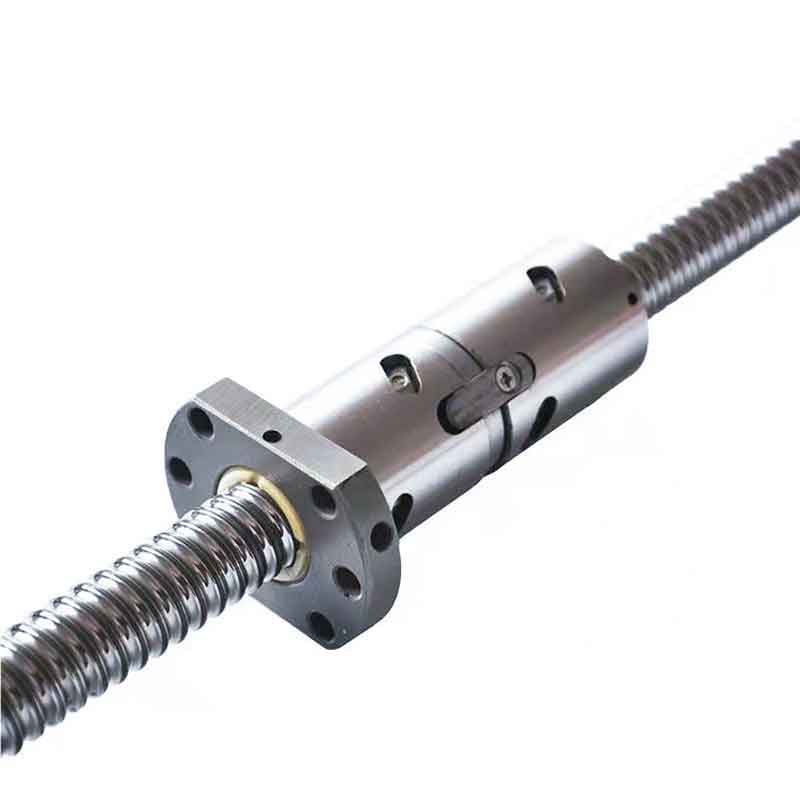
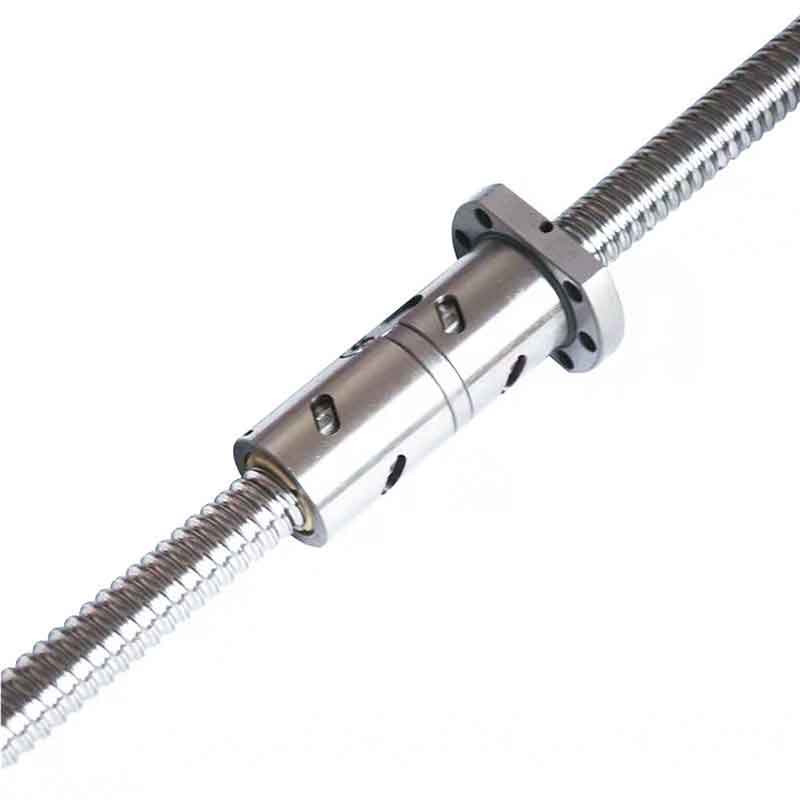
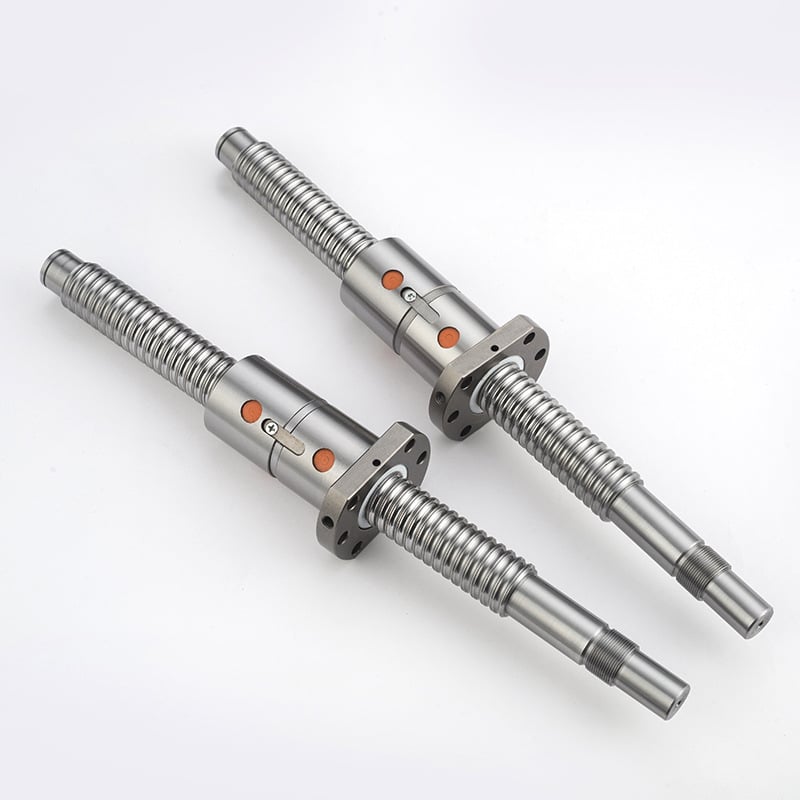
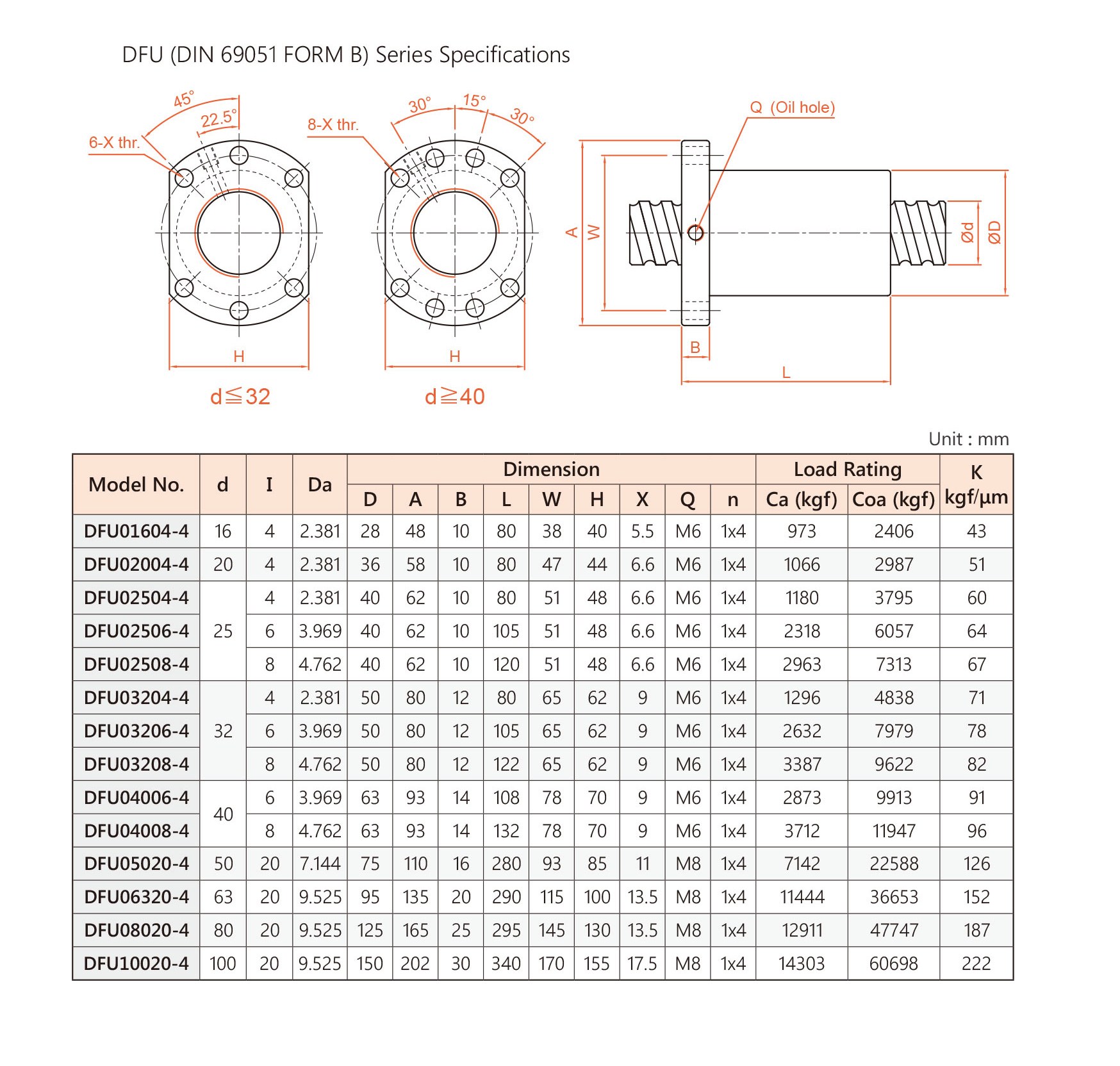
Positioning: A flanged-mounted, double-nut preloaded, high-rigidity/high-precision ball screw assembly. It is a solution designed for high-end applications demanding zero backlash, ultra-high rigidity, high load capacity, and long service life.
Nomenclature Interpretation:
- D: Double Nut. The core feature, consisting of two nuts combined via a preload method.
- F: Flanged. The nut incorporates a square or circular flange for easy mounting and fixation.
- U: Typically represents "Ultra Precision" or a specific high-performance grade. Sometimes refers to a particular preloading method.
Core Value: The preloaded double-nut structure actively eliminates axial clearance and provides far superior rigidity and load capacity compared to single-nut ball screws.
II. Core Structure and Working Principle
Double-Nut Preload Structure (Core):
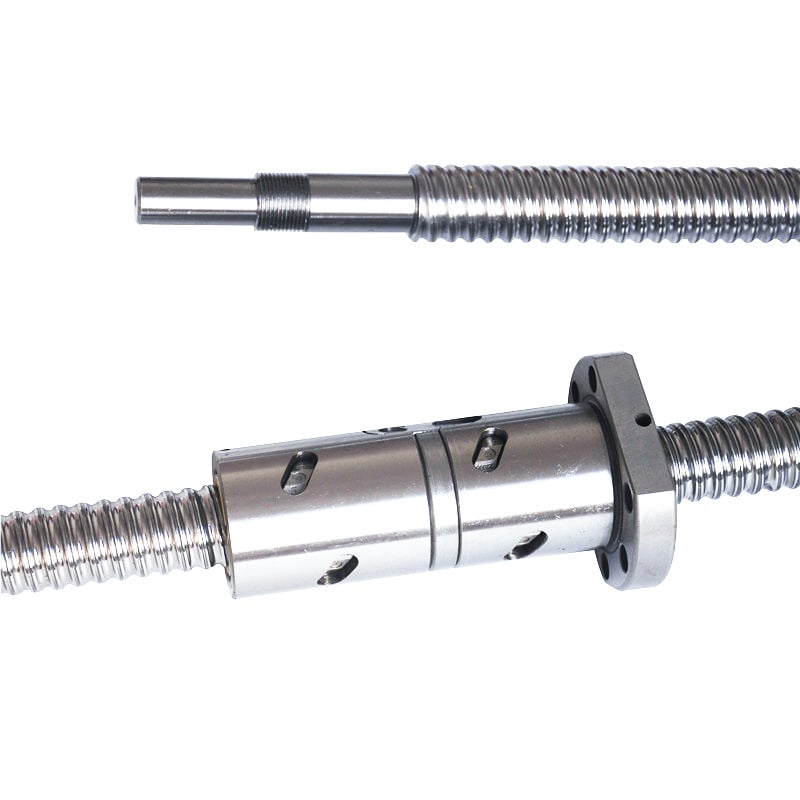
- The DFU consists of two independent ball nuts. A preload adjustment element (e.g., preload spacer, spring, or threaded sleeve) applies an opposing axial force between them.
- Working Principle: The preload forces the ball raceways of the two nuts to press against opposite flanks of the screw shaft's threads. Regardless of whether the screw is under forward or reverse load, one nut's balls are always under load. This completely eliminates axial clearance (achieving zero backlash) and significantly increases system rigidity.
Preload Methods:
- Spacer Preload: Precision spacers of varying thickness are inserted between the nuts. Simple structure, highest rigidity, fixed preload value, but adjustment is inconvenient.
- Spring Preload: Preload force is applied via disc spring sets. Compensates for wear and thermal expansion, maintaining constant preload, but rigidity is slightly lower than spacer preload.
- Threaded Preload: The relative position of the two nuts is adjusted and locked via a threaded sleeve. Adjustable, but rigidity depends on the locking force.
Flanged Nut:
- Incorporates a robust, integrated flange providing a large mounting surface. It is fixed to the worktable with multiple screws, offering excellent connection rigidity and easy installation.
High-Precision Screw Shaft:
- Manufactured using precision grinding processes, typically achieving high lead accuracy grades like C7, C5, or even C3. Features superior material and heat treatment.
III. Core Performance Advantages
- Zero Backlash and Ultra-High Positioning Accuracy:The preloaded double-nut design completely eliminates axial clearance, achieving true "zero backlash" transmission. This is critical for applications requiring extremely high repeatability, bidirectional positioning, and no reversal shock (e.g., precision measurement, lithography machines, high-performance machine tools).
- Exceptional Axial Rigidity:The double-nut structure provides over twice the axial rigidity of a single-nut screw pair. Minimal deflection under high axial loads ensures motion accuracy and stability during heavy cutting or high-load conditions.
- High Load Capacity and Long Service Life:The two nuts share the load, increasing the overall dynamic and static load ratings. Preload also improves load distribution on the balls, contributing to longer life.
- Excellent Motion Smoothness:Eliminating clearance results in smooth, shock-free direction reversal and eliminates stick-slip (crawling) during low-speed operation, delivering superior motion characteristics.
IV. Comparison with Single-Nut Ball Screws (e.g., SFU)
| Feature |
DFU (Double-Nut Preloaded Type) |
Single-Nut Type (e.g., SFU) |
| Axial Clearance |
Zero backlash (eliminated via preload). |
May have micron-level clearance, or limited elimination via internal single-nut preload (oversized balls). |
| Axial Rigidity |
Extremely high (2x or more). |
High, but has a theoretical upper limit. |
| Load Capacity |
Higher (load shared by two nuts). |
High. |
| Motion Characteristics |
Identical in forward/reverse, no shock during reversal, excellent smoothness. |
May have a reversal dead zone, slight shock during reversal. |
| Structural Complexity & Cost |
Complex structure, high cost. |
Simple structure, lower cost. |
| Applicable Scenarios |
Cutting-edge equipment with ultra-high precision, high rigidity, and zero-backlash requirements. |
The vast majority of general industrial equipment requiring high precision and high speed. |
| Friction & Temperature Rise |
Preload increases friction and operating temperature rise to some extent. |
Relatively lower friction and temperature rise. |
V. Typical Application Fields
DFU ball screws are designed specifically for top-tier equipment with extreme performance demands:
- Ultra-Precision CNC Machine Tools: Feed axes for precision machining centers, jig grinders, ultra-precision lathes.
- Semiconductor Manufacturing Equipment: Nanometer-positioning stages in lithography machines, wafer inspection equipment, die bonders.
- Precision Measuring Instruments: Core drive axes for Coordinate Measuring Machines (CMMs), laser interferometers, vision measuring systems.
- High-End Additive Manufacturing Equipment: Powder spreading and build cylinder drives in industrial metal 3D printers.
- Aerospace Manufacturing Equipment: Composite fiber placement machines, high-precision 5-axis machining centers.
- Precision Optical & Electro-Optical Equipment: Telescope pointing systems, precision drive axes for laser cutting/engraving machines.
VI. Selection and Usage Guidelines
- Necessity Assessment: Consider the double-nut solution only when a single-nut screw (even with internal preload) cannot meet requirements for rigidity, backlash, or life. Its higher cost and complexity require thorough justification.
- Preload Method Selection:
- Spacer Preload: Suitable for stable loads, applications with extreme rigidity requirements, and where preload change is undesirable (e.g., heavy-duty machine tools).
- Spring Preload: Suitable for complex conditions involving wear or thermal expansion where constant preload is needed (e.g., long-stroke, high-precision measuring equipment
- Accuracy Grade Matching: The screw shaft must be selected with a C7 or higher accuracy grade matching the system's target precision.
- System Thermal Management: Double-nut preload generates higher friction and potentially more heat. For high-speed or long-stroke applications, consider screw cooling (e.g., coolant through a hollow screw) or forced cooling measures.
- Professional Installation: Correct preload adjustment of the two nuts and precise alignment of the screw shaft with the drive motor and support bearings are critical during installation.
The DFU (and similar double-nut preloaded) ball screw represents an advanced solution in ball screw technology for pursuing "zero backlash" and "extreme rigidity." Through its ingenious yet complex double-nut preload structure, it sacrifices some cost and operational efficiency (increased friction) in exchange for a qualitative leap in bidirectional positioning accuracy, system rigidity, and load capacity. It is one of the most powerful and reliable core mechanical transmission components available to precision equipment designers facing the most stringent motion control performance requirements. Choosing DFU means laying a solid and reliable foundation for a machine's top-tier performance.

 EN
EN