EN
EN
Quick Links

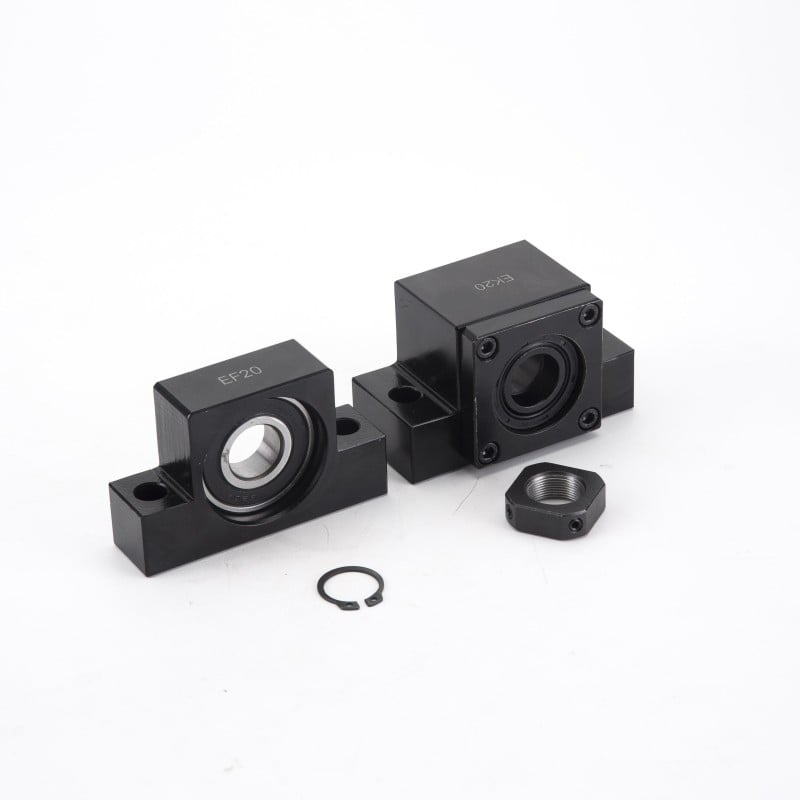
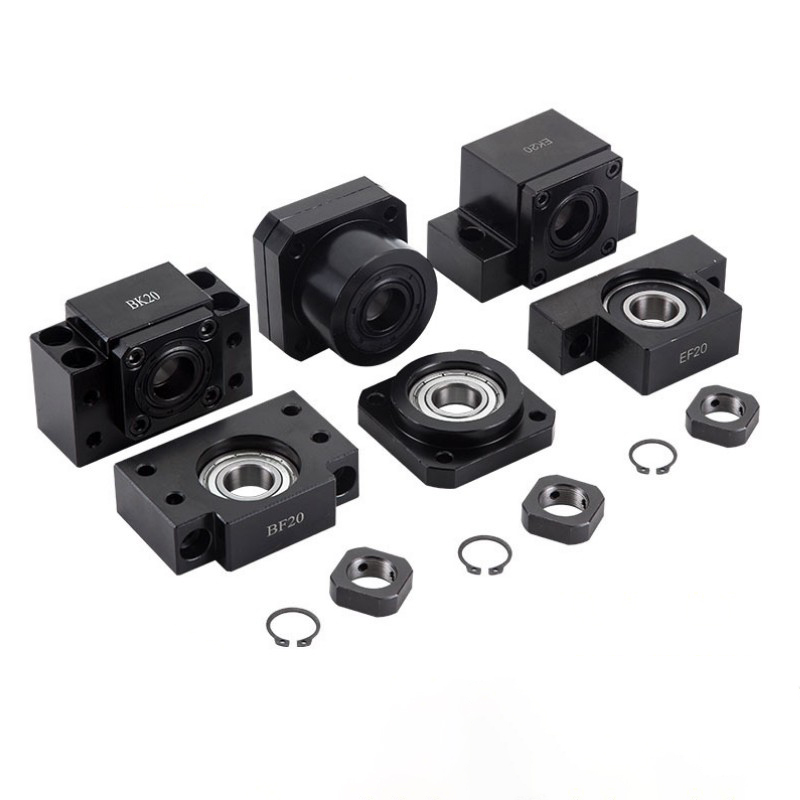
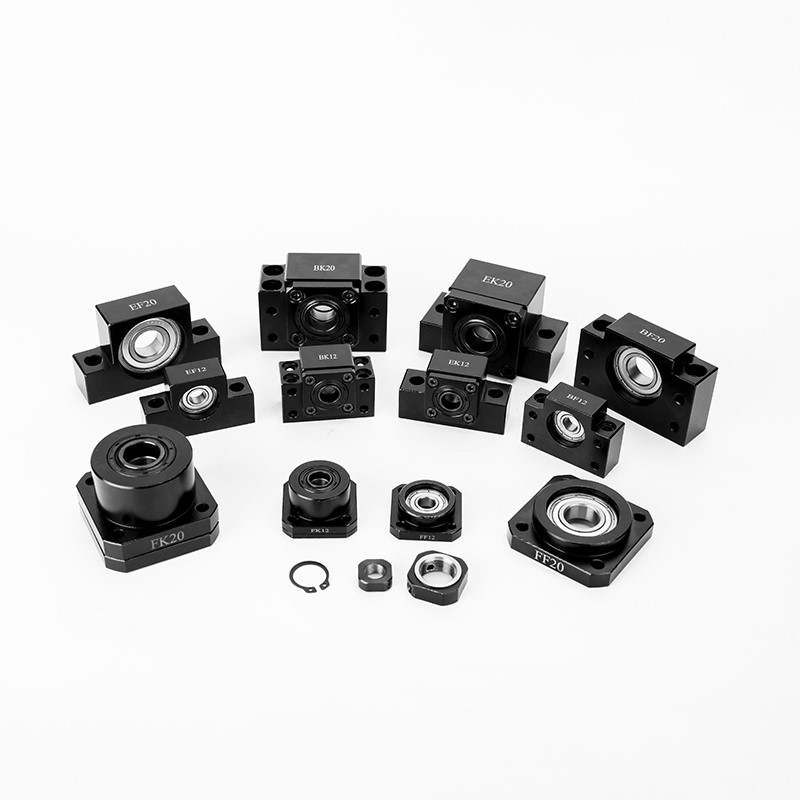
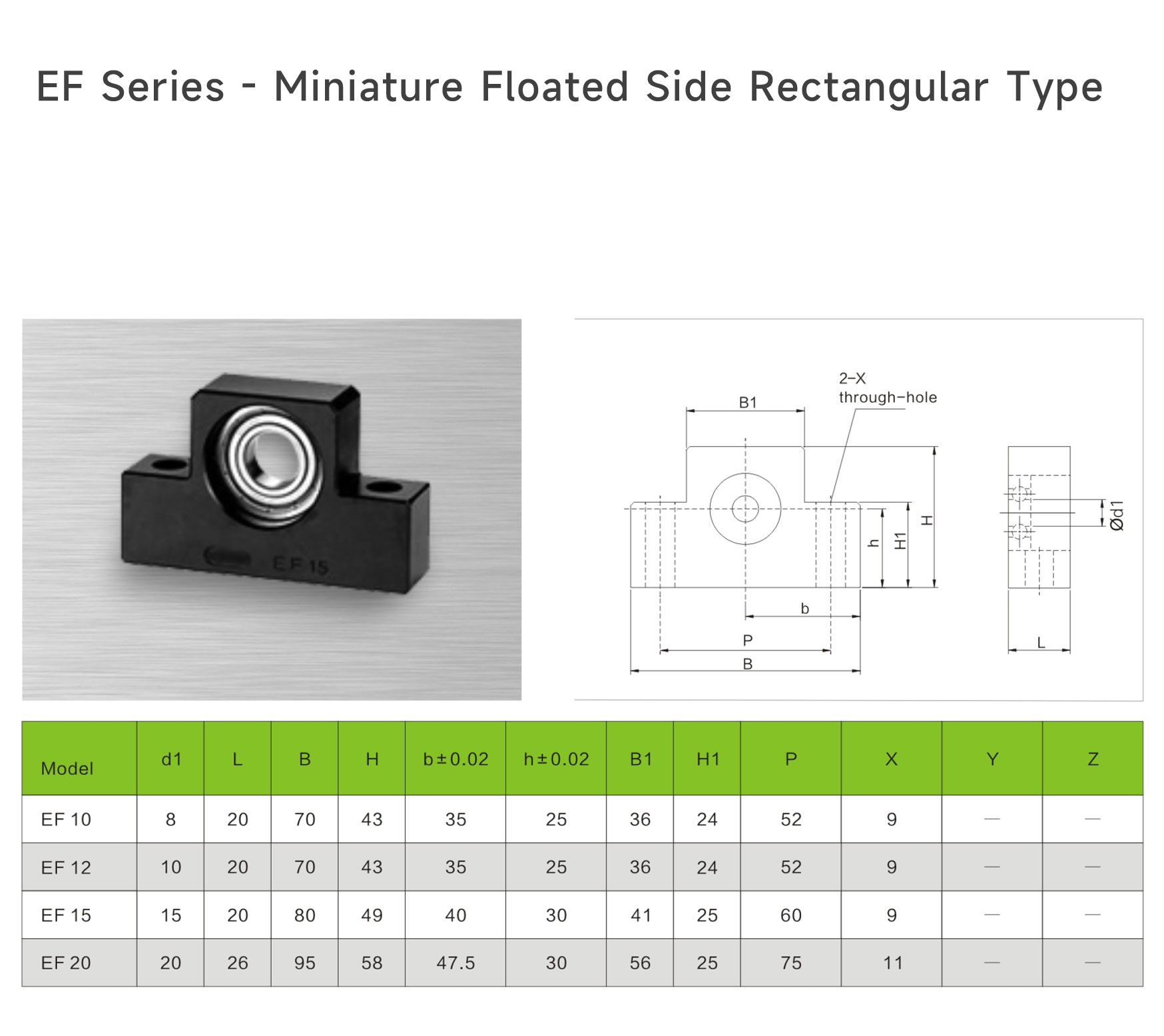
"EF" is a specific type of ball screw "support side (floating end)" support unit, specifically denoting a "floating end support unit employing an eccentric locking collar mechanism."
Positioning: A floating end support unit for ball screws that uses an eccentric locking collar to connect to the screw shaft.
Nomenclature Interpretation:
Core Value: It combines the installation convenience of the eccentric locking collar with the thermal expansion relief function of the floating end, providing a perfect standardized solution for the floating end of plain shaft ball screws without shoulders.
The EF unit is a fusion of structure (E-type locking) and function (F-type floating):
Eccentric Locking Collar Mechanism:
Uses identical components to the EK unit. A slotted sleeve with an eccentric lug and a locking ring securely connects the support unit to the plain screw shaft using radial clamping force.
Floating Bearing Mechanism:
Internally, it typically employs a deep groove ball bearing (same as BF). The bearing outer ring is axially located at one end within the housing, with clearance left at the other end.
The bearing inner ring has an interference or tight fit with the eccentric sleeve, which in turn grips the screw shaft via friction. Therefore, the entire bearing-eccentric sleeve assembly can slide axially within the housing.
Working Principle Process:
Perfect Match for EK Fixed End:
This is the most typical and logical application scenario for EF. When the fixed end uses EK (due to employing a plain shaft screw), the floating end should naturally be EF to maintain consistency in the locking method and installation convenience. They are inherent partners.
Suitable for Floating End of Plain Shafts Without Shoulders:
Solves the problem of how to reliably connect and allow axial float for plain shaft screws at the floating end. No need to machine any steps or threads on the plain shaft for axial limitation.
Combines Installation Convenience and Floating Function:
Saves Axial Space:
Like EK, the EF has a compact structure. It does not rely on shaft shoulders and retaining rings for axial limitation (in some designs) like traditional BF units, benefiting space-constrained layouts.
For a typical cost-effective, easy-to-install system using standard plain shaft ball screws, the optimal support combination is:
This combination achieves:
| Feature | EF (Eccentric Locking Floating End) | BF (Standard Floating End) |
| Screw Shaft End Requirement | Plain shaft is sufficient. | Typically requires retaining ring grooves or a step on the screw shaft end to axially locate the bearing inner ring (preventing it from sliding off the shaft end), though overall screw float is allowed. |
| Locking/Connection Method | Radial friction locking (eccentric sleeve). | Clearance/transition fit + axial mechanical limitation (retaining ring, end cover). |
| Installation Convenience | Very high. Connection strength is controlled by tightening torque and is adjustable. | High, but requires proper installation of retaining rings and certain shaft tolerance requirements. |
| Best Partner | EK fixed end. | BK fixed end. |
| Design Focus | Optimized for plain shaft screw systems, emphasizing installation convenience and system consistency. | Designed for traditional standard screw systems, most widely used, most classic technology. |
The application scenarios for EF support units are closely linked to its partner EK, particularly suitable for:
Systematic Selection: EF should not typically be selected alone but considered as a system together with the EK fixed end.
Confirm Screw Type: Must confirm the use of a plain shaft ball screw without shoulders.
Correct Installation:
Avoid Additional Axial Constraints: Like BF, at the EF end, the screw shaft must not be connected to any component that would restrict its axial float (e.g., a rigidly connected encoder).
The EF support unit is an ingenious crystallization of eccentric locking technology (E) and floating end functionality (F). It fills the standardization gap for "floating end support for plain shaft ball screws." Together with the EK fixed end, it forms a complete, elegant, and user-friendly ball screw support solution. Choosing EF (paired with EK) means opting for an engineering path that maximizes installation convenience, minimizes screw machining costs, and sacrifices no core performance. It represents the thorough implementation of the modern mechanical design philosophy of "easy to manufacture, easy to assemble, easy to maintain."
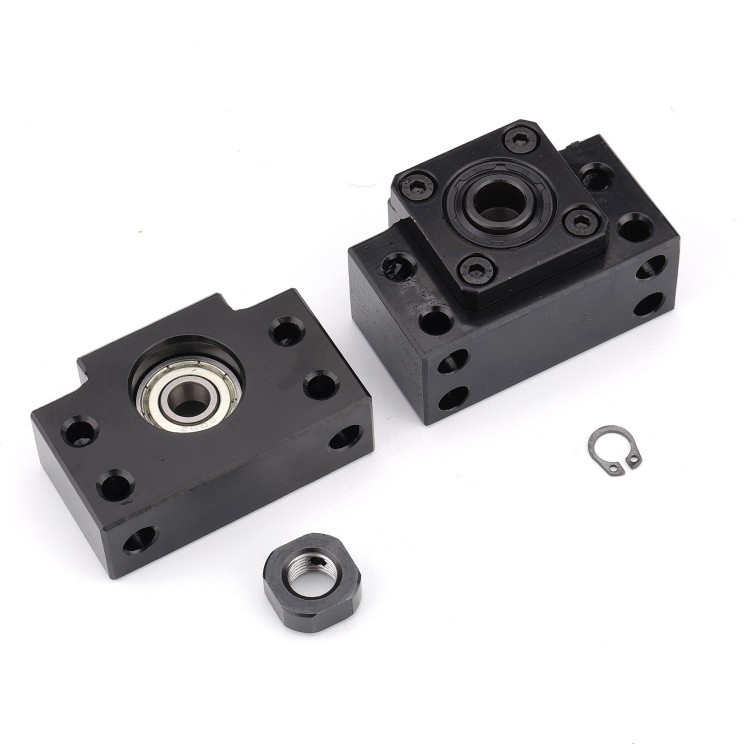
BK series ball screw end support
LM series linear shaft bearing
EGW Series Linear Guideway
MGW series linear guideway